
Non-suicidal self-injury among adolescents attending child and adolescent psychiatry consultations at Mohammed VI University Hospital in Marrakesh: a retrospective descriptive study of 50 cases
Période d’étude : 2021-2026
DOI:
https://doi.org/10.65549/x2m68837Keywords:
Self-injury; adolescent; child and adolescent psychiatry; mental healthAbstract
Objective. To describe the epidemiological, clinical and psychosocial profile of adolescents presenting with non-suicidal self-injury (NSSI) and followed in child and adolescent psychiatry consultations at Mohammed VI University Hospital in Marrakesh, as well as the characteristics of self-injury, anatomical sites, psychiatric comorbidities and management.
Methods. This was a retrospective descriptive single-centre study of 50 adolescents followed between 2021 and 2026 in the outpatient child and adolescent psychiatry unit of Mohammed VI University Hospital in Marrakesh. Data were collected from medical records using a standardized data collection form and analysed descriptively.
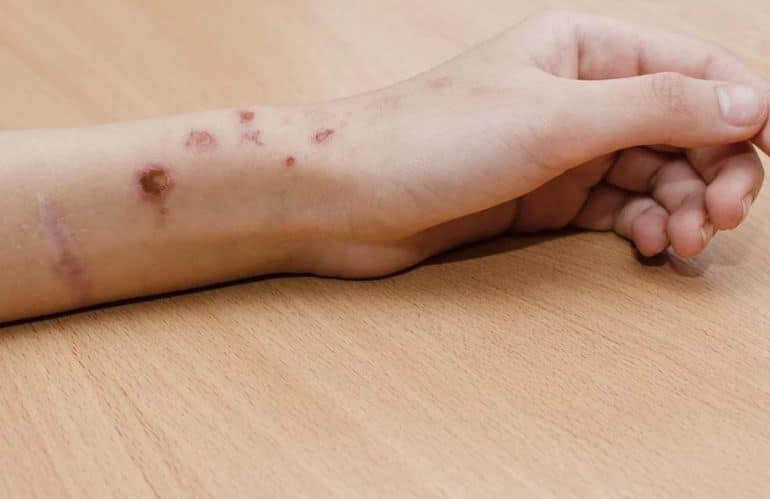
Results. The mean age was 15.28 ± 1.14 years, and the mean age at onset of self-injury was 13.62 ± 1.26 years. Girls accounted for 68% of the sample. Self-injury was repetitive or recurrent in 76% of cases, and an identifiable trigger was found in 80%. The upper limbs were involved in 92% of adolescents, with the left forearm being the most frequent specific site (26%). Relief of emotional tension was the main reported function (34%), and 58% reported temporary relief after the act. Mood disorders were present in 54%, anxiety disorders in 38%, and trauma-related disorders in 26%. Major family conflicts and peer difficulties were each identified in 46% of adolescents.
Conclusion. In this outpatient clinical population, non-suicidal self-injury was frequently repetitive, predominantly involved the upper limbs, and was associated with substantial emotional, psychiatric and psychosocial burden. Assessment of emotional dysregulation, psychiatric comorbidities and the family and social environment is essential for appropriate management.
Downloads
References
[1] Brown RC, Plener PL. Non-suicidal Self-Injury in Adolescence. Current Psychiatry Reports. 2017;19:20. doi:10.1007/s11920-017-0767-9.
[2] Evseev VD, Bokhan NA, Mandel AI, Kadochnikova SV. Prevalence and risk factors of non-suicidal self-injury behavior. S.S. Korsakov Journal of Neurology and Psychiatry. 2024;124(2):13-19. doi:10.17116/jnevro202412402113.
[3] Khutoryanskaya YV, Pozdnyak VV, Grechanyy SV. Nonsuicidal Self-Injury Behavior in Adolescents. Neuroscience and Behavioral Physiology. 2023;53(6):973-980. doi:10.1007/s11055-023-01490-w.
[4] Vafaei T, Samavi SA, Whisenhunt JL, Najarpourian S. An investigation of self-injury in female adolescents: a qualitative study. Quality & Quantity. 2023. doi:10.1007/s11135-023-01632-9.
[5] Calvo N, Lugo-Marín J, Oriol M, Pérez-Galbarro C, Restoy D, Ramos-Quiroga JA, Ferrer M. Childhood maltreatment and non-suicidal self-injury in adolescent population: A systematic review and meta-analysis. Child Abuse & Neglect. 2024;157:107048. doi:10.1016/j.chiabu.2024.107048.
[6] Liang Y, Chen J, Xiong Y, Wang Q, Ren P. Profiles and Transitions of Non-Suicidal Self-Injury and Depressive Symptoms among Adolescent Boys and Girls: Predictive Role of Bullying Victimization. Journal of Youth and Adolescence. 2023;52:1705-1720. doi:10.1007/s10964-023-01779-6.
[7] Hafissi M, Aabbassi B, Manoudi F. Profil épidémiologique des tentatives de suicide chez les adolescents : étude rétrospective au CHU Mohammed VI de Marrakech (2021-2025). Revue de Psychiatrie et de Psychologie de l’Enfant et de l’Adolescent. 2026;12(1):1-19. doi:10.65549/hgh1mj52.
Downloads
Published
Issue
Section
License
Copyright (c) 2026 Journal of Child and Adolescent Psychiatry and Psychology

This work is licensed under a Creative Commons Attribution-NonCommercial-ShareAlike 4.0 International License.
Esta obra está bajo una licencia internacional Creative Commons Atribución-NoComercial-CompartirIgual 4.0.


